
Method and measurement · Method note 01
Gap analysis: how this site decides what is worth writing down
Three stages, four confidence flags and two legal limits: the test a note has to pass before Sushasan Labs publishes it.
English हिंदी सारांश
Writing about delivery programmes can go wrong in two ways. It can stop at the complaint, a list of what is broken. Or it can move straight to a recommendation without showing how the problem was established. Neither helps the person who would have to act on it.
This note sets out the test that analysis notes on this site have to pass before publication. It is public so that readers can check the work against it.
1. The three stages
Each analysis note is built in three stages, in this order, and is published once all three exist in writing. Method notes such as this one describe the rules and do not follow the three-stage form.
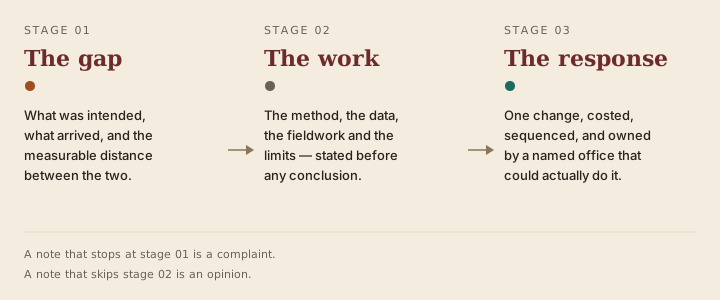
Stage 01 — the gap
A gap statement has three parts: what the programme was designed to do, what reached people, and the distance between the two in a unit a reader could check. “Implementation is weak” is not a gap statement. “The scheme guarantees a placement follow-up at three months; in the districts examined, the follow-up register had not been completed for the most recent cohort” is one.
Stage 02 — the work
The work section says how the gap was established: which documents, which datasets, how many interviews and with whom, what was counted and what was estimated. It states the limits before the conclusion, so that the reader can weigh what follows.
Stage 03 — the response
One change, costed and sequenced, for a named office that could carry it out within an existing budget line. A list of recommendations, or a general call for “greater convergence”, does not meet this. If no such change can be described from the evidence, the work is not finished and the note waits.
Name the gap in a unit someone can check, show the work before the conclusion, and propose one change an office could make. The method in one sentence
2. The four confidence flags
External claims in a note carry one of four flags in the running text. The flags are letters, so they survive printing, screen readers and being pasted into an email.
| Flag | Means | Reader should |
|---|---|---|
| V Verified | Read in the primary source (the Act, the rule, the notification, the dataset), and the source is linked. | Treat as citable. |
| S Secondary | Reported by a credible third party; the primary document was not obtained. | Cite the original reporter, not this note. |
| A Anecdotal | From interviews or field observation, with the number of sources stated. | Read as testimony, not as measurement. |
| U Unverified | Believed true but not confirmed. The note says how it could be checked. | Check before quoting. |
An unverified claim is flagged and kept, with a note on how it could be checked, so that readers can see where the evidence is weak. If a flagged claim turns out to be wrong, it is corrected under the corrections policy.
3. Two legal limits
Two features of Indian law limit what Sushasan Labs can obtain and reuse. The first changed in 2025, so older guidance may be out of date.
Access to records
Section 44(3) of the Digital Personal Data Protection Act, 2023 amends section 8(1)(j) of the Right to Information Act, 2005. The amendment is reported to have taken effect in November 2025. S1 The amended clause exempts personal information without the public-interest test it used to contain; the general override in section 8(2) remains. In practice, requests that touch personal information, such as beneficiary lists or individual records, are likely to be harder to obtain.
For this reason the method relies on aggregate registers, programme and budget documents, and interviews. It avoids arguments that would need individual-level personal data. Where a claim would need such data, it is flagged U.
According to the Press Information Bureau, the Digital Personal Data Protection Rules were notified on 14 November 2025 and allow an eighteen-month period for phased compliance. S2
Reuse of government documents
Works of the Government of India are protected by copyright for sixty years. Section 52(1)(q) of the Copyright Act, 1957 permits reproduction of certain government works, including Acts (with commentary), reports of committees laid before the legislature, and court judgments, subject to conditions. V3 The Government Open Data Licence – India is a separate licence with its own terms and is not the same as CC BY.
So government tables are cited, linked and reused on their own terms, and derived figures are labelled as derived. The CC BY 4.0 licence on this site applies to original text and analysis, not to source material.
4. Where the work begins
The method applies to any public programme. The first analysis notes are on skilling and livelihoods. School education in India has a long-running household survey of children’s learning, the Annual Status of Education Report. Sushasan Labs has not found a comparable independent, regular survey of delivery outcomes in skilling, although ministry annual reports and industry employability reports are published. S4
5. What would make this note wrong
Two things. First, the three-stage test may prove too demanding in practice. If stage 03 cannot be completed for most real delivery gaps, the standard will need revising. Second, the flags may become routine, applied by habit and not by checking, in which case they stop carrying information.
Readers who see either problem are asked to report it. The corrections policy covers complaints about method as well as about facts.
सारांश (हिंदी)
यहाँ छपने वाला हर विश्लेषण नोट तीन चरणों में लिखा जाता है, और तीनों पूरे होने के बाद ही प्रकाशित होता है।
- चरण एक — अंतर: योजना का उद्देश्य क्या था, लोगों तक असल में क्या पहुँचा, और दोनों के बीच कितना अंतर है — ऐसी इकाई में जिसे कोई भी जाँच सके।
- चरण दो — काम: यह अंतर कैसे निकाला गया — कौन-से दस्तावेज़, कौन-से आँकड़े, कितने साक्षात्कार। साक्ष्य की सीमाएँ निष्कर्ष से पहले बताई जाती हैं।
- चरण तीन — सुझाव: एक बदलाव, उसकी लागत और क्रम के साथ, उस कार्यालय के नाम जो उसे कर सकता हो।
बाहरी दावों के साथ चार में से एक चिह्न लगाया जाता है: V सत्यापित, S दूसरे स्रोत से, A साक्षात्कार पर आधारित, और U असत्यापित। असत्यापित दावे को हटाया नहीं जाता; उस पर चिह्न लगाया जाता है और लिखा जाता है कि उसे कैसे जाँचा जा सकता है।
दो क़ानूनी सीमाएँ इस काम पर असर डालती हैं। पहली: सूचना का अधिकार अधिनियम की धारा 8(1)(j) में हुए संशोधन के बाद व्यक्तिगत जानकारी पाना पहले से कठिन हो सकता है। दूसरी: सरकारी दस्तावेज़ों पर कॉपीराइट होता है; कॉपीराइट अधिनियम की धारा 52(1)(q) कुछ सरकारी दस्तावेज़ों को शर्तों के साथ दोबारा छापने की अनुमति देती है, और GODL-India लाइसेंस CC BY जैसा नहीं है।
Notes and sources
- Digital Personal Data Protection Act, 2023, s.44(3), amending the Right to Information Act, 2005, s.8(1)(j). The Press Information Bureau explainer of 17 November 2025 confirms that the Act revises section 8(1)(j): PIB document. The commencement date comes from secondary reporting, and the gazette notification is not linked here, so the claim is flagged S. ↩
- Digital Personal Data Protection Rules, 2025: notification date and the eighteen-month period for phased compliance, as stated by the Press Information Bureau on 17 November 2025: PIB document. ↩
- Copyright Act, 1957, s.52(1)(q), on the Copyright Office site: exceptions to infringement. Government Open Data Licence – India: gazette notification. ↩
- Based on a review by Sushasan Labs in 2026 of organisations’ published outputs. The review is not exhaustive. For the school survey, see the ASER Centre. ↩
How to cite this note
Sushasan Labs (2026) ‘Gap analysis: how this site decides what is worth writing down’, Sushasan Labs Method Note 01. https://sushasanlabs.in/article. Licensed CC BY 4.0.
- Address
- https://sushasanlabs.in/article
- Licence
- CC BY 4.0: reuse and translate with attribution
- Version
- 1.0. Substantive changes are logged in the corrections log.
BibTeX
@misc{sushasanlabs2026gap,
  author    = {{Sushasan Labs}},
  title     = {Gap analysis: how this site decides what is worth writing down},
  year      = {2026},
  publisher = {Sushasan Labs},
  series    = {Sushasan Labs Method Notes},
  number    = {1},
  url       = {https://sushasanlabs.in/article},
  note      = {Licensed CC BY 4.0.}
}